









‘Rosemead’ Review: Lucy Liu Dives Head First Into Overwhelming Misery
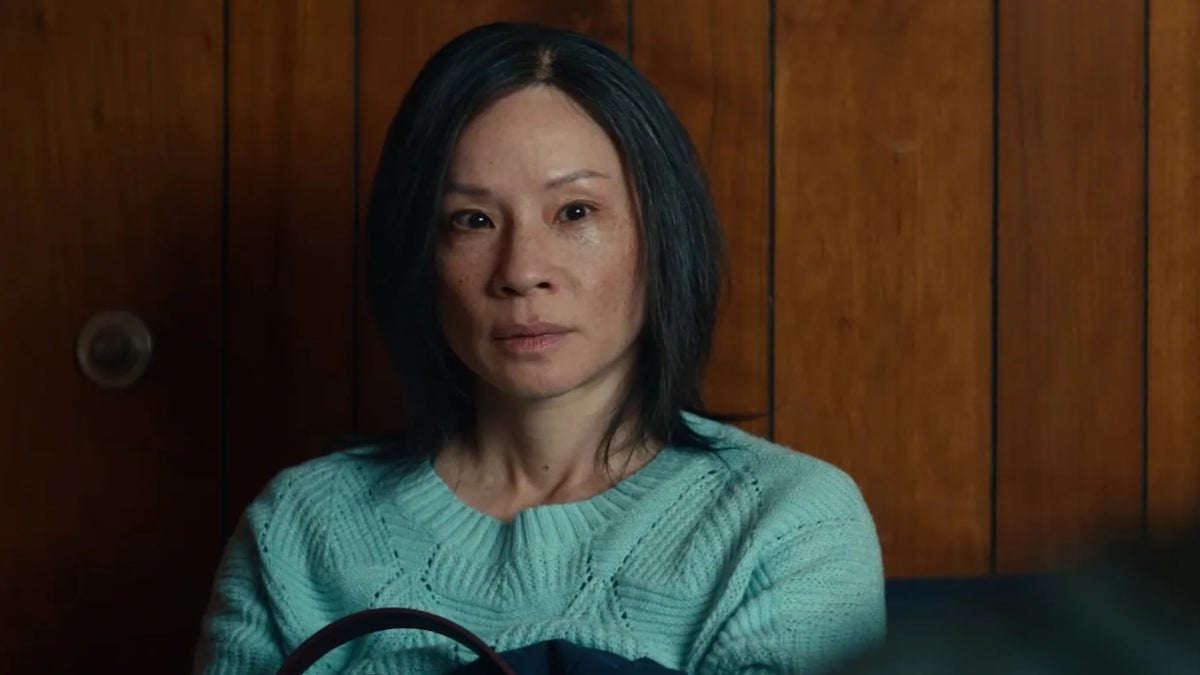
Eric Lin’s “Rosemead” begins when Lucy Liu, playing a widow who runs a print shop in Southern California, coughs a little. So we immediately know she’s got terminal cancer. If you’re coughing in a movie and you’re not in a room full of smoke, and it’s not already established that you’ve got a cold, it means you’re dying from cancer. I don’t make the rules, I just know them by heart. It’s like when any woman throws up in a movie, and they’re not drunk and they didn’t get food poisoning, it means they’re pregnant. Every. Single. Time.
In “Rosemead,” Lucy Liu plays Irene. Her husband died a couple years ago. Irene is dying now. Her teenage son Joe (Lawrence Shou) has schizophrenia and isn’t taking his meds. Also, he’s obsessed with school shootings. This is not a film where nice things happen. This film is bleakness personified.
If “Rosemead” wasn’t based on a true story, the filmmakers would probably get accused of laying it on too thick. As it stands, one might be tempted to give them a pass, but then again, they’re the ones who chose this material. They wanted to tell a heavy-handed, tragic story about misery, and also some misery, and also more misery. If you can believe it, Irene’s story actually gets harder to watch from there. My god, what a nightmare.
Here in Los Angeles we have a program at the American Cinematheque every year called, “Bleak Week: Cinema of Despair.” It’s a film festival that only shows the saddest movies ever made, like John McNaughton’s “Henry: Portrait of a Serial Killer” and Isao Takahata’s “Grave of the Fireflies.” It’s been going strong for four years, so there’s clearly an audience for films like “Rosemead.” You may or may not be in that audience. You probably already know if you are.
Maybe mainstream audiences are spoiled. Maybe too many American films are cheerful, escapist entertainments. Maybe mass-produced art shields us from life’s harshest realities, and as such, fails to prepare us for when our own lives turn sour. Films like “Rosemead” are a splash of ice water in our smiling faces — grim, fatalistic reminders that here, but for the grace of caprice, we go. I’ll give Eric Lin’s movie credit: It’s making me think about the place grim and punishing art has, not just in our lives, but also in the marketplace. Someone people want to pay to be sad. Like the great Sally Sparrow said, sadness is “happy for deep people.”
But beyond the misery, and pity, and the ugly sense of relief we get that our lives (hopefully) aren’t this grim, what are we supposed to get out of “Rosemead?” It’s a very specific tragedy, and Marilyn Fu’s screenplay goes out of its way, mostly, to avoid any suggestion that there’s a sweeping message. There’s a danger in not raising awareness but there’s a danger in raising awareness through scare tactics and scapegoats, and “Rosemead” arguably blurs that line, although probably unintentionally.
School shootings are a pervasive, shocking problem and we all wish we could do something to prevent them (not that our government is trying anything). Irene is aware of the danger and wants to avoid the looming disaster, but Joe’s warning signs — disturbing images in notebooks, internet browser histories with Wikipedia pages about other killers, as well as gun shops — are all wrapped up in his schizophrenia, which is omnipresent throughout the narrative.
When Irene talks to Dr. Hsu (James Chen) about her fears, he’s quick to point out that “most people with schizophrenia don’t engage in violence, in fact it’s quite rare.” That’s what he’s telling us, but not what the film is showing us. We see no examples in “Rosemead” of people living with schizophrenia who aren’t a serious danger to themselves and others. And to be frank, Dr. Hsu doesn’t seem to be doing a great job, so all the hard work falls to Irene, who is ill-equipped for a million reasons, and her solution to Joe’s problem is… bad. Let’s just call it bad. So Dr. Hsu isn’t exactly wowing us with his grasp on the situation, and the film’s one paltry attempt to consciously avoid linking schizophrenia to school shootings isn’t nearly as convincing as it definitely should be.
There’s an argument to be made that “Rosemead,” as frank as it is about emotional horrors (and other horrors as well) doesn’t do a great job of justifying its assault on the audience’s sense. It’s an effective assault, no doubt about that, and Lucy Liu dives headlong into this abject anguish with an open heart and a lot of skill. I don’t know nearly enough about schizophrenia to judge whether Lawrence Shou is accurately conveying the experience to the audience, so I’ll yield the floor if any experts that want to share their judgment, but he is fully committed to the film, I can say that much. As a result he’ll probably make you sad as hell. Which was indeed his job.
Is “Rosemead” a good movie? I’m not sure I’d go that far. It turns our hearts upside down, and that’s by design, so if nothing else it’s functional. But I’m not convinced it has enough to say about its sorrow, or that it has any helpful ideas about how we, the audience, can do about it. We just don’t have enough control over our mental and physical health to completely avoid these circumstances in our own lives, as unlikely as they are to happen again in exactly this way.
I guess we’re just supposed to not do whatever Irene does, even though what Irene does was significant enough — for worse, definitely not for better — to get memorialized in a movie. Which might not be the best way to look at it, but it’s an interpretation “Rosemead” leaves open, so I’m afraid I have to call it. However depressing “Rosemead” is, and it’s depressing in all italics, it’s just not deep enough to make running this gauntlet worthwhile.
The post ‘Rosemead’ Review: Lucy Liu Dives Head First Into Overwhelming Misery appeared first on TheWrap.
What's Your Reaction?
 Like
0
Like
0
 Dislike
0
Dislike
0
 Love
0
Love
0
 Funny
0
Funny
0
 Angry
0
Angry
0
 Sad
0
Sad
0
 Wow
0
Wow
0